(205) 633-3606


(205) 633-3606



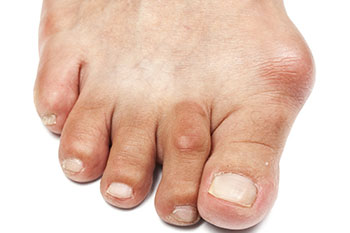
A bunion is a bony, painful swelling that is often formed on the first joint of the big toe. Bunions can be extremely painful due to the weight of all your body resting on it each time you take a step. Everyday activities, such as walking and wearing shoes, can cause you extreme discomfort if you have a bunion.
Reasons that a person may develop a bunion can vary. Some patients may form bunions due to genetic factors, complications with arthritis, or a weak foot structure. General aging can also play a role in the formation of a bunion.
If you have a bunion, you may notice a bony bump on your big toe, experience swelling and redness, and the area may feel tender to the touch. To help alleviate the pain that often comes with having a bunion, it’s suggested to maintain a healthy weight to help lessen the pressure on your toe, practice both heating and icing the affected area, wear wide-fitting shoes wear to leave plenty of space for your toes and to minimize rubbing, and look into shoe inserts that can help position your foot correctly.
Because bunions can result in other painful foot problems, such as hammertoes and bursitis, we recommend that you meet with a podiatrist for a professional diagnosis and for information regarding all your treatment options.
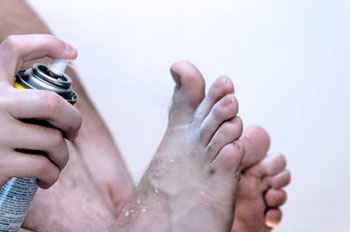
Athlete’s foot is a fungal infection that’s highly contagious and can be spread through direct skin to skin contact as well as indirect contact. Athlete’s foot can be spread directly when an uninfected person touches the infected area of someone who has athlete’s foot. The condition can be spread indirectly through contaminated surfaces, clothing, socks, shoes, bed sheets, and towels.
Areas that are known to be damp, warm, or humid are commonly known to be more susceptible to carrying the fungal infection. With that being said, you should use caution around swimming pools and communal showers to avoid picking up athlete’s foot. If you know you have a weaker immune system, you should also be sure to use caution around these types of environments.
Those who are affected by athlete’s foot may experience symptoms such as cracking, dryness, flakiness, itchiness, redness, or scaliness of the skin of the foot or in between the toes. Oozing, crusting, swelling, and the formation of blisters are other symptoms that may arise due to athlete’s foot.
If athlete’s foot goes untreated, there is a high risk that it may spread from toe to toe. With this in mind, it’s highly recommended that you meet with a podiatrist for a professional diagnosis. Your podiatrist can give you information about treatment options that best suit your case.
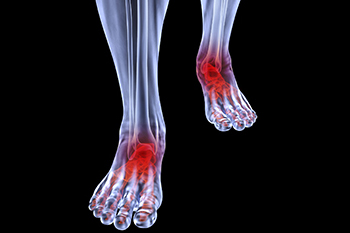
Conditions affecting the feet due to complications with arthritis can take many forms, including osteoarthritis, rheumatoid arthritis, gout, psoriatic arthritis, and ankylosing spondylitis. Osteoarthritis typically affects the joint connecting your big toe to your foot, though it can also be found in the midfoot region. Unlike osteoarthritis, rheumatoid arthritis typically affects both feet and deals with the same joints on each foot. Gout, which normally affects the big toe, is comprised of needle-like crystals that trigger inflammation in the joints. Psoriatic arthritis causes sausage-like swelling in the toes. Lastly, ankylosing spondylitis can lead to plantar fasciitis and pain at the Achilles tendon.
Many factors play a role in the cause for arthritic feet, including obesity, the aging process, as well as family history or genetic connections to arthritis.To help prevent issues with your feet, examine your feet daily, keep your feet clean, routinely moisturize your feet, keep your toenails trimmed, inspect your shoes for anything that may cause discomfort, and wear socks on a daily basis.
If you’re experiencing any discomfort or pain due to one of the above forms of arthritis, consider over-the-counter pain medication and investing in comfortable footwear. Pain medication coupled with top of the line comfort footwear is a great way to ease the pain that often comes with arthritis. If you’re overweight, it’s also recommended to think about setting a weight loss goal to ease some of the pressure on your feet, as well stay as active as possible. Applying ice or heat to the affected area is another way to calm the discomfort you may experience. It’s important to do research and see whether inserts may be beneficial for you. General foot care, like pampering your feet and keeping them well maintained, is also recommended. Lastly, you should seek professional advice and learn about potential surgery options, if necessary.
For an official diagnosis and information on treatment options, consult with a podiatrist.
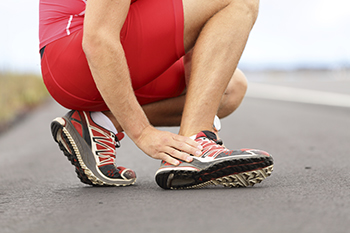
Ankle pain, while initially thought of as an issue for athletes, can affect anyone at anytime. Simple, everyday activities, such as walking or running on an uneven surface, have the possibility of causing serious harm to one’s ankle. That is, however, not to discount athletic injuries; in fact, half of all ankle sprains are inflicted during an athletic activity. The most common causes of ankle injuries include tripping or falling, landing awkwardly after jumping, a sudden impact such as a car crash, or twisting, rolling, and rotating of the ankle.
Some signs that point to the potential of an ankle injury include pain towards the affected area, swelling, bruising, or an inability to walk or bear weight on the affected area. You may also notice an increase in the height of the arch of the inflicted foot. In order to understand why the injury occurred, a podiatrist will often question the patient about the events leading up to their ankle discomfort. An x-ray of the leg or foot may also be performed to discover what’s harming the ankle.
There are many different types of ankle injuries, such as ankle sprains, fractures, strains, and tendonitis. To relieve discomfort caused by these conditions, it’s recommended to get plenty of rest, use ice to reduce swelling and ease pain, compress the injured ankle by wrapping it for support, and elevate the ankle to reduce swelling.
If you or someone you know is experiencing pain or discomfort in the ankle region, seek out the help of a podiatrist for a proper diagnosis and treatment regime.
535 Jack Warner Parkway NE
Suite 1A
Tuscaloosa, AL 35404
P: (205) 633-3606
F: (205) 633-3696
| Mon: | 8:00 AM - 5:00 PM* |
| Tues: | 8:00 AM - 5:00 PM** |
| Wed: | 8:00 AM - 5:00 PM** |
| Thur: | 8:00 AM - 5:00 PM** |
| Fri: | 8:00 AM - 12:00 PM*** |
| *Closed for lunch from 12:00 PM - 1:30 PM | |
| **Closed for lunch from 12:00 PM - 1:00 PM | |
| ***Staff only | |